


Signs and symptoms
A hoof abscess often appears suddenly and can be very distressing for both you and your horse. One of the most obvious signs is sudden, severe lameness. Your horse may refuse to put weight on the affected hoof even when they appeared sound just hours before1. You might also notice that the hoof or lower leg feels warmer than usual, which is a sign of localised heat caused by infection2. Another key indicator is a strong digital pulse, which you can feel near the fetlock or pastern.
In some cases, swelling can develop around the coronary band or pastern and can sometimes extend up the leg1. A foul smell or discharge may appear around the sole or coronary band2. If you apply pressure with hoof testers, your horse will likely react, showing just how painful the abscess has become.
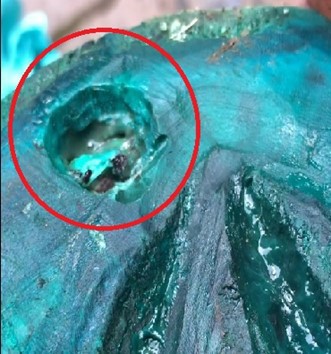
The highlighted area shows the exit hole of a hoof abscess. Photo credit: Nigel Brown AWCF.
Causes
Hoof abscesses occur when bacteria manage to enter the hoof and become trapped inside. This can happen through tiny cracks/gaps in the hoof wall or white line, which may not be visible to the naked eye. Puncture wounds from sharp objects like nails are another common way for bacteria to get in.
Rapid changes between wet and dry conditions can weaken the hoof, increasing vulnerability2. Long intervals between farrier visits can also lead to flares or stretched white lines, giving bacteria a route in1. Deep bruising from hard ground or sharp objects may also develop into an abscess over time3. Abscesses occur more frequently during spring and autumn due to environmental stresses2.
What to do if your horse is suddenly non-weight bearing
If your horse suddenly refuses to bear weight, check carefully for signs of sole penetration, wounds or heat in the hoof2. Keep an eye out for major swelling that may be a sign of damage to other internal structures of the limb2. If a foreign object is present, don’t remove it, as this could cause additional damage. Contact your vet immediately for urgent assessment2.
Treatment
To diagnose a hoof abscess, your farrier or vet will begin by asking about your horse’s recent management, farrier schedule, turnout routine and the timeline of symptoms2.They’ll examine the hoof and limb and use hoof testers to identify painful areas1. If your horse is shod, they may need to remove the shoe on the affected hoof. In severe cases, X-rays may be recommended, particularly if a puncture wound or penetration injury is suspected or the abscess is difficult to locate2.
Treatment aims to relieve the pressure inside the hoof. Once the abscess is located, it may be opened using a hoof knife to allow drainage, which often brings immediate relief1.
Warm epsom salt soaks can help draw out any remaining infection and poultice pads may be used and changed daily or every other day2. It’s important that any bandages applied aren’t too tight around the coronary band. You should be able to fit your finger between the bandage and coronary band all the way around2.
Pain relief can be prescribed by your vet, and antibiotics can be used for deeper or more complex infections2.
Recovery time varies depending on severity. Mild abscesses can resolve within a few days to a week, while deeper or higher abscesses can take several weeks or even months2. Abscesses in hind feet sometimes take longer to heal as more weight is carried in their front hooves, helping the abscess to drain faster2. If left untreated, an abscess can lead to deeper infections or even laminitis, making prompt treatment essential2.
Prevention
Good hoof care is the best way to prevent abscesses from developing. Regular farrier visits help maintain hoof balance and integrity, reducing the risk of cracks or gaps.
Keeping your horse’s environment clean and dry is also essential, as prolonged exposure to mud or wet ground can weaken the hoof wall. Make it a habit to pick out your horse’s hooves daily, removing stones and checking for any signs of injury. Treat any cracks or injuries promptly to stop bacteria from entering and causing problems.