Changing Lives Through Horses is all about creating a sense of belonging for children and young people. Our programme is designed for those who might find emotional connections difficult in educational and social environments. The themes that come through from speaking with our young people involve belonging, trust, being listened to, safety and acceptance.
As one of our Approved Centres, it’s an opportunity for you to work inclusively with a diverse range of children and young people within their communities. You’ll be giving them the chance to develop new skills and build their confidence all while experiencing the magic of our four-legged friends.
Who will I be working with?
- Those with additional needs in the widest sense
- Those with Education, Health, Care Plans (or IDPs)
- Adverse childhood experiences and trauma
- Excluded, at risk of exclusion or isolation
- Social work or health referrals, including social prescribing
- Post 16 NEET
- Youth Service and mentoring service referrals
- Care experienced
- Electively home educated children
- Emotionally and anxiety based non-school attendance
What requirements will I need?
To deliver the Changing Lives Through Horses programme, a centre would need to meet the following criteria:
- Be a BHS Approved Centre which makes sure that we can maintain a secure and safe environment for young people to be working in. Find out more about becoming an approved centre here.
- We require the Lead Changing Lives Through Horses Coach to be qualified to BHS Stage 3 Care (or equivalent) and BHS Stage 2 teach, or BHS Coaching4All qualification and recommended to be an Approved Professional Coach. This makes sure that we're delivering with coaches who have up-to-date safeguarding training, first aid and are DBS checked according to their national requirements (other centre staff can be involved in the delivery of the programme, it's just the lead coach that needs to hold the above requirements).
- The Lead Changing Lives Through Horses Coach and your centre staff will be required to attend two initial group virtual training sessions and then three further bespoke training sessions.
- Centres will continue to receive ongoing training, support and guidance from a dedicated CLTH team and have access to all the wider BHS approved centre services.
What support will I get with session plans?
Our Changing Lives Through Horses team will provide you with carefully developed medium-term plans to deliver engaging and educational sessions. These plans make sure that life skills and curriculum-linked learning are seamlessly integrated into each session.
Medium-Term Plans: These plans are different from regular session plans. While we know our coaches are experts in teaching equine skills, these plans will help you incorporate life skills and curriculum-linked learning into the sessions. All these plans are provided to centres in our handbooks, organised by topic.
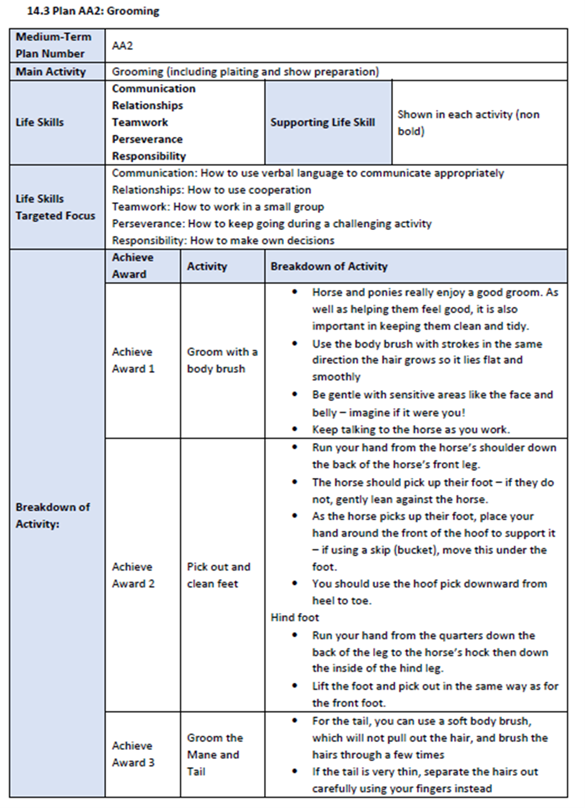
Example Plan: Let’s take a look at an example of a medium-term plan focused on grooming, taken from our England handbook. Each plan is divided into three sections and designed by activity type.
- Topic and Life Skills: At the top, the topic is listed along with the life skills that can be developed through the activities. For instance, grooming can help develop communication skills.
- Awards and Skill Levels: The first section lists all the awards related to the topic. It provides a breakdown of the activities, and the level of skill required for participants to complete the section.
- Life Skills and Curriculum Links: The second section links the activities to life skills and curriculum points. For example, during a grooming lesson, participants might be asked questions about the type of brush, its colour, and the pony they are working with. This turns grooming into a communication exercise. If participants are answering, being polite and engaged (or working towards that), the activity is a success!
- School Curriculum Points: The third section lists the school curriculum points that can be covered within the topic, broken down by level and subject. For example, discussing the brushes and their textures can support English language skills by using adjectives and descriptive words.