

The journey
The Coast to Coast Path National Trail: A journey towards multi-user access
The Coast to Coast Path National Trail, inspired by Alfred Wainwright’s iconic 190-mile route from St Bees in Cumbria to Robin Hood’s Bay in North Yorkshire, stands as one of England’s most beloved long-distance paths.
Traversing stunning landscapes including the Lake District, Yorkshire Dales, and North York Moors National Parks, the trail attracts thousands of adventurers each year. The route has been officially designated as a National Trail, with a £5.6 million government investment announced in August 2022.
Background to the designation
chevron-down
chevron-up
The idea of elevating the Wainwright Coast to Coast to National Trail status originally came from the Wainwright Society, but the recent impetus dates back to the UK Government’s 2019 election manifesto, aiming to celebrate and improve this popular path.
Natural England prepared a formal proposal to designate the route as a National Trail in 2021 and, since approval, have been working with the six delivery partners - Cumberland, Westmorland & Furness, and North Yorkshire Councils; along with Lake District, Yorkshire Dales, and North York Moors National Park Authorities - to secure the route and bring the Trail up to National Trail quality standards through improved surfacing, signage and furniture.
Consultation and collaboration
chevron-down
chevron-up
National Trails established under the National Parks and Access to the Countryside Act 1949 were created as a series of promoted long-distance routes for use “on foot, on horseback, or on a bicycle”.
Despite this, most of England’s 16 National Trails prioritise walkers, with only two - the South Downs Way and Pennine Bridleway - fully accommodating cyclists and horse riders.
The initial proposals for the Coast to Coast National Trail combined existing footpaths - excluding cyclists and horse riders - and bridleways - which permit them - resulting in a fragmented experience for non-walkers, limiting the trail’s appeal and the wider economic benefits for rural communities. British Horse Society and Cycling UK argued that a more inclusive, braided, design approach could boost tourism, extend the visitor season, and support local businesses, drawing parallels to established multi-user routes like Spain’s Camino de Santiago.
The challenge prompted a positive resolution. In December 2022, DEFRA, Natural England, British Horse Society and Cycling UK began working together to look at opportunities to develop a a complementary “Riders Route” supporting the main walking path. While some sections will remain designated as footpaths, a braided approach will address those gaps and, in time, ensure a continuous route for all users, promoting safer, more inclusive adventures.
This collaborative approach highlights the importance of advocacy in shaping access policy and in securing an inclusive, multi-user, approach to future route development.
Trialling a formalised Riders Route
chevron-down
chevron-up
As a result of stakeholder collaboration, potential conflict has been transformed into opportunity.
Our initial work has secured an alternative braided route through the Yorkshire Dales Section of the Coast to Coast, from Orton to Richmond. The braided route will be signposted at those locations where the riders route diverges from the formal (walking) route. At each point, there will be waymarks that link riders directly to this website.
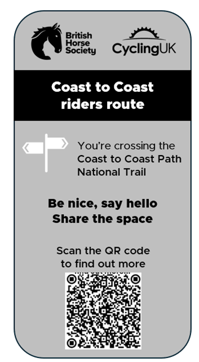
The intent is that riders can then use this information - including downloadable GPX routes - to divert along the alternative route before re-joining the formal route along the ‘legal’ sections (i.e. those sections that use bridleways, byways and other accessible routes).
At the moment, this is a trial project in order to assess the efficacy and impact of this semi-formalised ‘riders route’ approach, and the alternative way-marking and use of GPX downloadable routes.
Both BHS and Natural England would be pleased to hear your feedback on how easy you found this solution, and any problems you have with the alternative route. Share feedback with us here.
Future development - a full coast to coast rider’s route
chevron-down
chevron-up
The trial section for the rider’s route is through the central section of the Yorkshire Dales National Park, and high credit goes to the National Park Authority for their proactive and inclusive approach to developing the route.
Dependent on the outcome of this initial trial riders route, we hope to extend the trial to develop a braided route along the full Coast to Coast route. We will also be looking to work with partners to identify stabling and transport options along the route in order to ensure that equestrian users can safely and comfortably enjoy a multi-day ride. Work with the National Park Authorities will continue, with a view to produce smaller, circular day-rides along sections of the Coast to Coast route.
Some of these proposals are longer term aspirations, but its only by staking our claim towards inclusion, and testing innovative solutions, that we can develop a full route that is accessible to equestrians and cyclists, and potentially extend successful ideas to other National Trail routes.
We believe that our work on the Coast to Coast exemplifies how collaboration can begin to unlock the countryside for all. Plan your adventure today and experience the spectacular scenery, and culture, of this national gem!
"A Long Green Trail"
National Trails lend much of their success to the visionary 1935 proposals - "A Long Green Trail" - by Tom Stephenson, for the creation of the Pennine Way. His vision was of a British equivalent to the 2,000-mile Appalachian Trail, encouraging people to better connect with nature and heritage, and to fully explore their home country.

What do you think?
Both BHS and Natural England would be pleased to hear your feedback on how easy you found this solution, and any problems you have with the alternative route.