Equine Infectious Anaemia (Swamp Fever)

What is Equine Infectious Anaemia?

Equine infectious anaemia (EIA), also known as Swamp Fever, is an infectious viral disease. The equine infectious anaemia virus (EIAV) is categorised as a lentivirus, and is related to the virus that causes HIV in humans. However, EIA affects horses, mules and donkeys only and cannot affect humans in any way. One of the key areas of concern with EIA is that infected animals can remain carriers of the disease for life and therefore be a potential source of infection to other horses. EIA occurs worldwide, with outbreaks regularly reported in the Americas, Asia, Africa, Australia and parts of Europe. Previous outbreaks have also occurred in Ireland and France.

Clinical Signs

The incubation period of EIA varies greatly, ranging from as short as three days for an acute infection to as long as three months. Typically, the incubation period is between one to three weeks.

Acute infection results in full clinical signs of the disease being displayed including:

  • High fever (40-42oC)

  • Increased heart and respiratory rate

  • Depression

  • Loss of co-ordination

  • Ataxia (rigidity of the muscles)

  • Pinpoint haemorrhages of conjunctiva and mucous membranes

  • Rapid weight loss

  • Lack of appetite

  • Bloody diarrhoea

  • Skin swelling, in particular of the abdomen and legs

  • Anaemia

  • Jaundice

  • In some cases the horse may suddenly die

Acute infection in pregnant mares may result in abortion, stillbirth or the birth of a weak foal (who may also be infected with EIA via placental transmission).

Acutely infected horses carry high levels of the virus in their blood and are a high risk source of infection to other animals. Animals that survive an acute infection often have recurring bouts of fever and anaemia and continue to be highly infectious.

Chronic infection of EIA often results in the following clinical signs, interspersed with periods of good health:

  • Recurring bouts of fever

  • Depression

  • Anaemia

  • Weight loss

  • Weakness

  • Lethargy

Veterinary authorities strongly advise that any horse showing signs of severe, unexplained anaemia should be isolated and tested as soon as possible for EIA.

Sub-clinical infection of EIA in horses often goes undetected as no clinical signs of the disease are shown. The horse will remain a carrier of EIA, but will not be as infectious as horses suffering with the acute form of the disease. A sub-clinical infection may become chronic or acute if the horse is subjected to hard work, severe stress or the presence of another disease(s).

Transmission

The transmission of the EIAV is via the transfer of infected blood or blood products to an uninfected susceptible animal. This can occur in a number of different ways, but the main transfer routes include:

  • Biting insects (vectors); such as horse, deer and stable flies and (very rarely) by mosquitoes. The vector bites and feeds from an infected horse transferring the virus when it moves to feed on an uninfected horse. Studies have shown that four hours after the vector's first feed, transmission of the EIAV was not successful so a second horse has to be bitten quite quickly for the disease to be passed on.

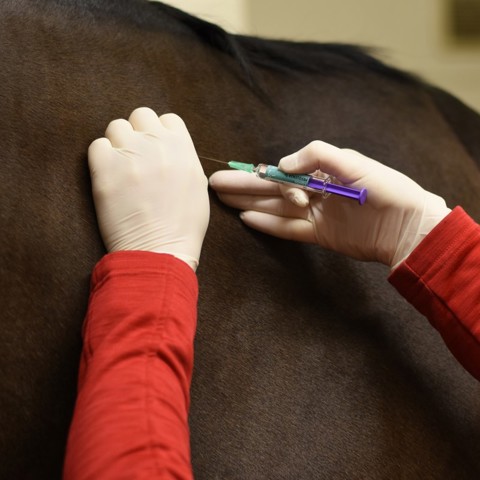
  • Contaminated veterinary or dental equipment; e.g. infected syringes, needles or surgical equipment.

  • Any other miscellaneous equipment contaminated by blood which poses a risk of transferring the disease.

  • Administration of infected blood products and the use of unauthorised blood-based veterinary products.

  • Via infected mares to their un-born foal via the placenta. There is also a risk of transmission via virus-contaminated colostrum or milk in newborn foals.

Transmission of EIA via a symptomatic stallion covering mares is uncommon but still a potential risk of infection.

The main concern with the EIAV is that recovered animals will remain infected for life, becoming a carrier of the disease and will continue to be a risk factor as a potential source of infection for other animals. Although clinically and sub-clinically affected horses are a potential risk of infection for other animals, the most highly infectious are those suffering acute disease or recurring bouts of chronic EIA.

Notification Procedures

In the UK, EIA is listed as a notifiable disease by law under a number of European Orders. This means that any horse suspected to be infected with EIA must be reported to the appropriate Divisional Veterinary Manager (DVM) of Defra.

Under the Order, Defra have the power to declare a suspected premises as infected and impose immediate restrictions on the horses at that establishment. Under the authority of the DVM a veterinary enquiry will be carried out to ascertain if EIA is actually present. Further measures including vector control and disinfection can also be enforced by Defra.

As no cure is currently available for EIA, a horse testing positive for the disease will be subject to compulsory slaughter and disposal under the control of the DVM. In 2006, the Equine Infectious Anaemia (Compensation) (England) Order 2006, came into force. The Order specifies the maximum rate of compensation to the value of £1 per animal subject to compulsory slaughter of EIA.

Control of Infection

The detection of infected animals is paramount in preventing the transmission of infection to other horses. Other important measures include insect vector control, avoiding high risk procedures and the prompt euthanasia of confirmed EIA infected animals.

If EIA is suspected, or a horse has been in contact with infected animals, the following actions should be taken:

  • All movements of horses on and off the premises should cease immediately.

  • Veterinary advice should be sought.

  • The suspected horse(s) should be immediately isolated, if possible in a vector-proof stable. All other horses that the potentially affected horse(s) has been in contact with should also be isolated.

  • The DVM should be notified and all instructions given by them must be adhered to.

  • All other horses must be kept away from potentially infected horses until the premises are confirmed as free from infection.

  • All non-urgent procedures that are a potential risk of transmission of infection should be postponed. For essential veterinary treatment, the use of one syringe and one needle should be strictly enforced for each horse. Any veterinary equipment used should be appropriately sterilised or destroyed after use.

  • As appropriate all stables, equipment and any vehicles a suspected horse has been in or used should be thoroughly cleaned and disinfected. Strict isolation management routines should be put into operation. Handlers/staff involved with potentially infected horses must disinfect their hands and change clothes before handling other horses.

  • The EIAV is able to survive in blood, tissue and faeces. All such matter should be removed and destroyed and all contact surfaces thoroughly disinfected.

Treatment

Currently there is no effective treatment for any form of EIA. Until the presence of the disease has been confirmed by blood samples using the Coggins test (laboratory test used to detect antibodies to EIA in infected horses), supportive veterinary treatment can be administered to ease the clinical signs associated with the infection. Under European regulations, a positive result will require compulsory slaughter of an infected animal.

Prevention

No vaccine is currently available to prevent EIA. The difficulty in producing a successful vaccine is that the EIAV has the capacity to change its protein structure, therefore making antibody development very difficult. A vaccine will need to be able to be effective against all variants of the virus.

The main method of prevention is the identification and control of infected horses. Studs often require mares to be blood tested before they are sent to stud, to ensure they are free from diseases including EIA. Stallions and teasers should also be tested to ensure they remain free from disease.

Any horse imported from an establishment suspected as being infected with EIA, should be isolated in a vector-proof stable immediately. The horse should be blood tested 30 days after the last known contact or importation date. Under the direction of the DVM, the horse should then be re-tested at 60 and 90 days. Each individual case should be carefully considered depending upon the circumstances and risk factors involved. All other horses on the yard must be carefully monitored and any concerns immediately reported to a veterinary surgeon and DVM.

EIA and Europe

When the European Union (EU) was expanded to include Romania, concerns were raised as EIA is endemic to the country yet the slaughter of infected animals is not compulsory in Romania. In response, the EU drew up strict guidelines on protective measures with regard to EIA in Romania which came into force on 3 May 2007.

On 15 June 2006 Ireland announced that EIA had been confirmed in horses on two stud farms, and in Northern Ireland on 1 September 2006, a foal was confirmed with EIA, making it the first case reported in the UK. The Irish Government committed substantial human and financial resources in order to control and eradicate the disease. Since December 2006 no EIA cases have been reported in Ireland.

Turkey has also made considerable effort and introduced a large testing programme to rid the country of EIA. Horses that test positive on the Coggins test will be subject to compulsory slaughter and the owners compensated.

Detailed information regarding the import and export requirements in relation to EIA and other diseases is available from Defra.

Further Information

For further information a copy of the HBLB Code of Practice is available upon request from the Welfare Department welfare@bhs.org.uk


join now
donate now
BHS Shop
your region